Everyone is a product manager now
The debate over whether engineers will replace product managers has the direction backwards. When execution is abundant, everyone becomes a PM.

Contents
Spend twenty minutes reading technology leadership threads right now and you will run into the same debate. One camp says AI coding agents have killed the product manager role, because engineers can now go straight from an idea to a working feature without waiting for a specification. The other camp says AI has killed the software engineer role, because product managers can now vibe-code features without waiting for an engineering sprint.
Both camps are looking at the same shift and misnaming the survivor. The engineer did not absorb the product manager, and the product manager did not replace the engineer. Everyone became a product manager.
When AI agents take over the mechanical execution of writing syntax, scaffolding tests, querying databases and triaging logs, look at what is left on a human builder’s desk at 9am:
- Figuring out which user problem actually matters this week
- Deciding what not to build so the product stays coherent
- Writing clear context and acceptance criteria so agents do not hallucinate scope
- Reviewing the output for proportionality, UX taste and edge-case bloat
- Measuring whether the shipped change moved retention or solved the user’s problem
That list is not traditional software engineering, and it is not slide-deck product management. It is hands-on, end-to-end product ownership.
“When implementation drops from two weeks to two hours, a four-stage human handoff chain stops being a quality control mechanism and becomes pure friction.”
Why the old squad model existed (and what AI broke)
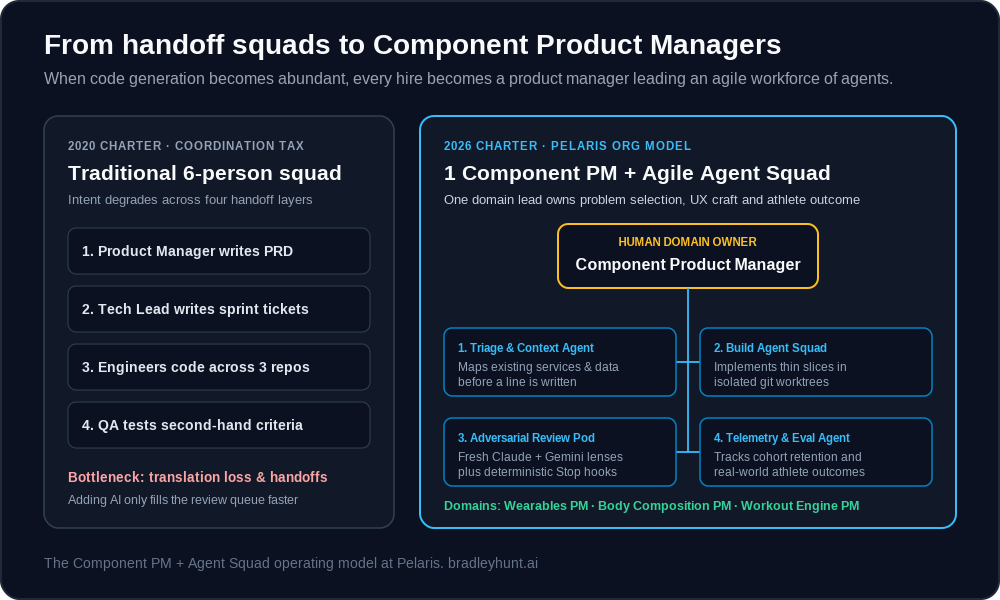
For the last twenty years, putting a mid-sized feature into production required a frontend engineer, a backend engineer, a mobile engineer, a QA analyst and a tech lead working for two or three weeks. Because five people cannot simultaneously interview customers, prioritise the roadmap, and hold 50,000 lines of syntax in their heads, companies split the role across four translation layers: Product Manager to PRD, Tech Lead to tickets, Engineers to code, and QA to testing.
That structure worked, but it carried a heavy translation tax. As Harvard Business School and Procter & Gamble’s field experiments with 776 professionals demonstrated, generative AI collapses traditional functional silos: individuals equipped with AI produced solutions matching the balanced quality of cross-functional two-person teams, breaking down the wall between technical and commercial specialists.
In software, what used to take three engineers a fortnight now takes an agent squad two hours inside a well-governed harness. It takes longer for a PM to write a six-page spec, book a grooming meeting, and explain the edge cases to four people than it takes one domain lead to direct an agent squad and put a working prototype on staging before lunch.
What happens when product leads run the whole loop
Building our engineering and product organisation at Pelaris around this operating model made the shift concrete very quickly.
Every day, our product workflow runs across what used to be four separate departments: analysing athlete feedback and Search Console data, deciding which problem is worth solving, mapping changes against PRODUCT.md and CODEBASE_MAP.md, dispatching parallel Claude Code sessions across isolated git worktrees, running proportionality and cross-model Gemini reviews, refining the UI feel by hand, and shipping to production.
In the missing middle, I wrote that AI compresses the climb from junior to mid-level execution while making deep domain judgment more valuable than ever. On the product side of the house, the exact same compression happens to the middle of product management: the backlog administrators, the ticket translators, and the status-update routers. What grows far more valuable is the builder who can hold the user’s reality and the system’s architecture in the same head.
How we hire at Pelaris: Component Product Managers
When people ask how we structure and scale roles at Pelaris, they often ask whether we hire traditional Flutter developers, backend Cloud Functions engineers, or spec-writing product managers.
The answer is none of those. Every product and engineering role at Pelaris is a Component Product Manager who owns a vertical of the platform end to end and leads an agile squad of AI agents to build, verify and improve that domain:
- The Workout & Periodisation Engine PM: Owns how training plans are generated, how fatigue and readiness signals adapt the week, and how strength, running, swimming and team-sport methodologies are encoded inside our Harbour harness
- The Wearables & Connected Devices PM: Owns our Garmin, Apple Health, Health Connect and
.FITfile pipelines, taking multi-step watch interval structures from athlete feedback to shipped Cloud Function schemas - The Body Composition & Blueprint PM: Owns the AI photo scan range estimator, DEXA and InBody sheet uploads, regional tracking, and the interactive body blueprint renderer
- The Growth & Interactive Tools PM: Owns our organic discovery loop, free sports-science calculators, conversion funnels, and cohort telemetry
Each Component PM directs a four-part agent squad:
- A Triage and Context Agent: Reads
CODEBASE_MAP.mdand existing domain rules before any change is proposed - A Build Agent Squad: Writes the Dart, TypeScript or Astro implementation and accompanying unit tests in isolated worktrees
- An Adversarial Review Pod: A fresh Claude reviewer plus a Gemini architectural lens, enforced by deterministic
Stophooks - A Telemetry and Evaluation Agent: Monitors production errors, latency and cohort retention after release
“The org chart of the next decade is not a taller pyramid of managers supervising people who type code. It is a flat network of domain owners leading agile squads of AI agents.”
Why technical depth still counts for every Component PM
Saying that everyone becomes a product manager does not mean engineering fundamentals stop mattering. Because AI agents default to over-engineering, a Component PM who cannot tell the difference between an 80-line extension of an existing service and a 1,500-line distributed state machine invented for an imaginary edge case will bury their component in technical debt inside a month.
The skill profile that wins in this model combines four capabilities:
- Deep domain empathy: Knowing what an athlete actually feels in week six of a marathon block, or what an enterprise operator actually needs on a Monday morning
- Context architecture: Maintaining a crisp 60-line stream
README.md, clean path-scoped.claude/rules/invariants, and unambiguous acceptance criteria - Systems and proportionality literacy: Reading architectural diagrams, inspecting data models, spotting race conditions or privacy leaks, and rejecting over-engineered diffs on sight
- Creative taste on the surface: Stepping in on the final 20% - the UI interaction, the visual clarity, the copy tone - where agents always flatten toward the average
Where to start if you lead a team today
Whether you are scaling a startup or reorganising a fifty-person enterprise platform group, four moves set this foundation:
- Stop hiring pure translators: Move roles whose primary output is retyping customer feedback into tickets for someone else into direct domain ownership with agent tooling
- Give engineers direct contact with the user problem: Replace pre-chewed ticket queues with end-to-end ownership of a user metric
- Give product managers read access and agent sandboxes: A PM who can query the codebase via MCP, inspect
CODEBASE_MAP.md, and prototype a thin slice in an isolated branch writes vastly better constraints - Build the shared harness once: Component PMs can move independently without breaking each other’s work only when the repository enforces deterministic hooks, path-scoped rules, and automated CI gates
Written by Bradley Hunt. For more on AI-first building and enterprise architecture, see the writing index.
Read next
Bradley Hunt
AI, engineering & leadership