How to structure a codebase for AI coding agents: what we replaced when 420k tokens of markdown broke
Adding more rules to a markdown file does not make an AI agent more reliable. Changing the harness does.
Contents
Every team building seriously with AI coding agents eventually hits the same wall. The setup that felt like magic at 10,000 lines of code starts actively working against you at 100,000.
For the first few months, the playbook seems obvious. Whenever an agent makes a mistake, you add a rule to CLAUDE.md. Whenever you finish a sprint, you append a post-mortem to lessons_learned.md. Whenever you design a feature, you drop a new folder into design_docs/. Whenever you run parallel tasks, you spin up another git worktree.
At Pelaris, we hit the tipping point of that approach at the end of October. We were burning tokens, consuming credits, and spending money needlessly on GitHub Actions, bloated context, and test suites that were running three times for every merge. Worse than the cost, our structure had turned needlessly complex, and because it was complex, it was falling further out of date every week.
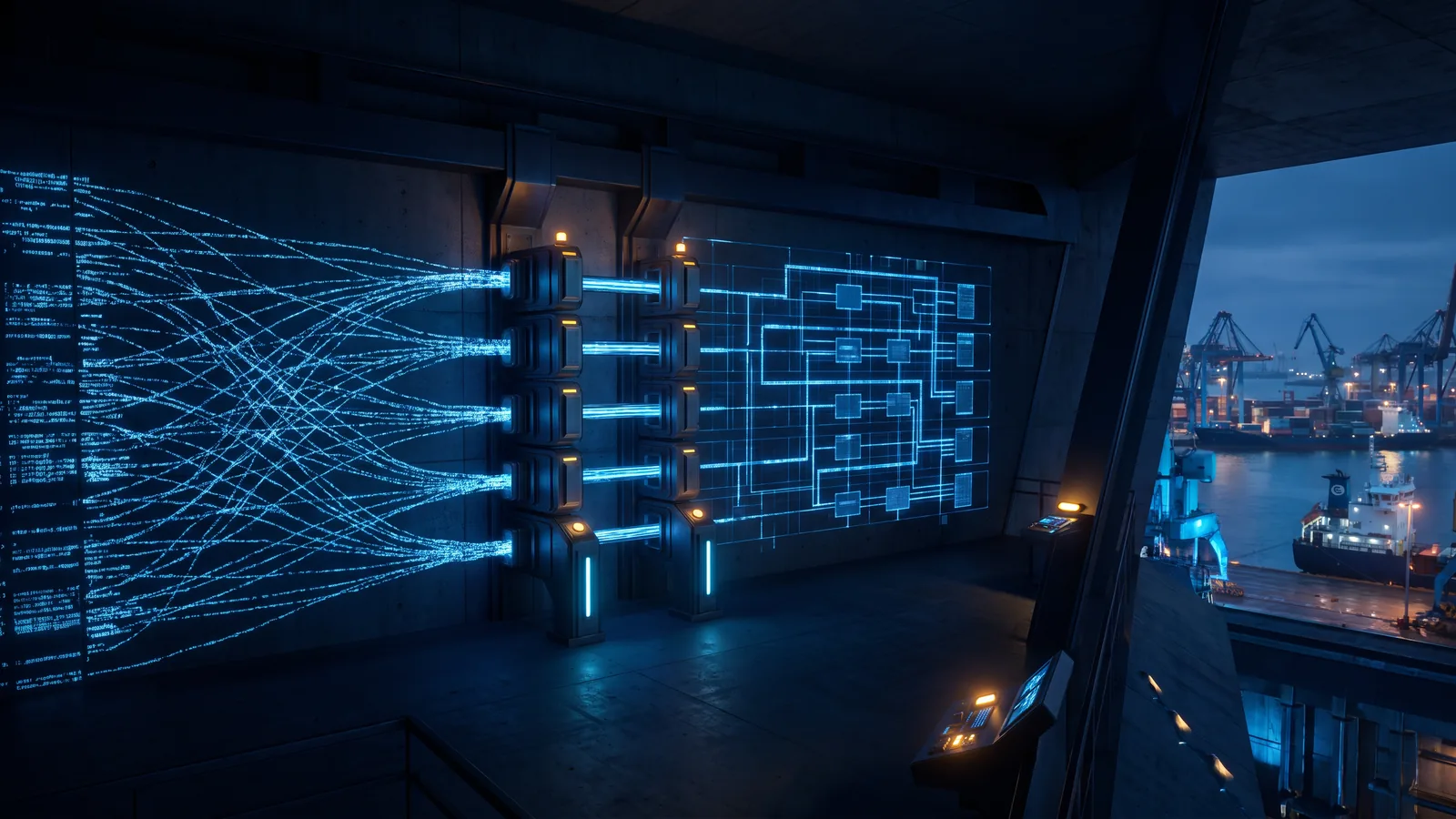
We paused feature work for a weekend and shipped an internal infrastructure release we called Harbour. We name all of our releases after the ocean and navigation - First Light, Tideway, Spring Tide, Harbour - partly because I grew up living in the pool and at the beach, and partly because the metaphor holds up. A harbour is the sheltered structure that lets you refit the ship and head back out into open water safely.
The edge-case spiral: why AI agents over-engineer by default
Before looking at file trees and hooks, it helps to name the behaviour that creates the mess in the first place.
The most frustrating habit AI coding agents have is designing for imaginary edge cases and enterprise scale when nobody asked for either. Left to their own devices, agents will take a problem that is used by one person - something that could honestly be HTML over an Excel sheet - and quietly build it on enterprise-grade infrastructure.
I see this constantly when running parallel sessions. An agent will stop mid-build and ask me to clarify a design requirement that makes no sense to me. When I dig into why it is asking, I find that the agent designed a feature to handle an edge case, inside a new helper it invented, to cover an edge case in my original design. It is an edge case on an edge case on an edge case.
Without structural boundaries, every session adds more defensive scaffolding, a parallel utility service, or another 300 lines of documentation explaining the scaffolding. Multiply that across hundreds of pull requests and five repositories, and the codebase accumulates structural debt faster than any human team could type it.
What our first-generation setup actually looked like
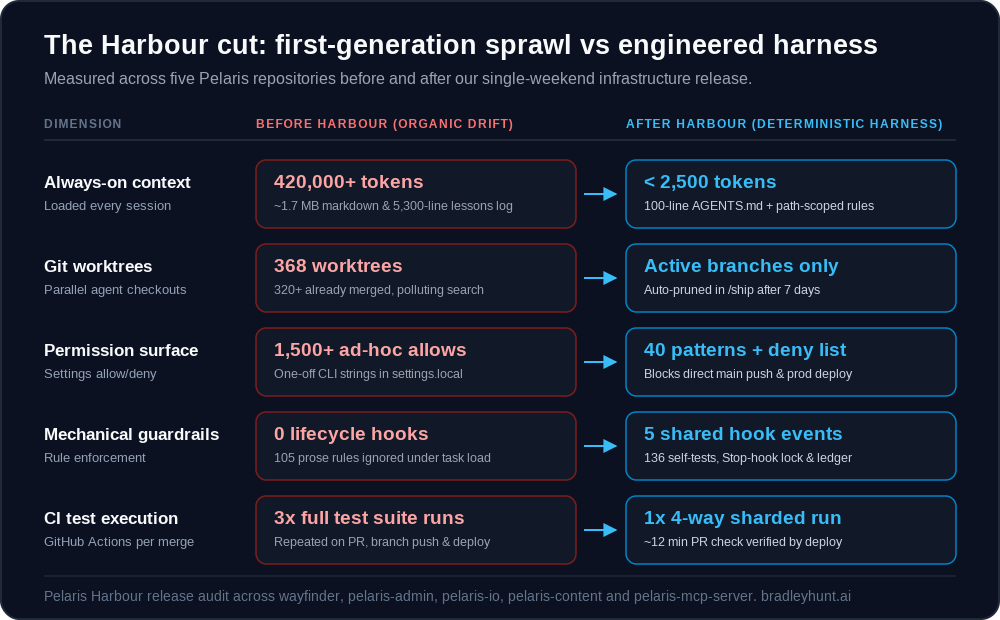
Before touching anything in Harbour, we ran a read-only audit across the workspace to measure what our agents were walking into at the start of a session:
- 420,000+ tokens of root markdown (~1.7 MB):
lessons_learned.mdalone had grown past 5,300 lines, anddata_model.md,features.md,architectural_context.mdandconventions.mdaccounted for another 900 KB between them - A split-brain timeline:
readme.mdtold every assistant to readcontext.mdfirst, whilecontext.mdstill described Sprint 10 from February and the live product was on Release 1.4.2 in late October - 140+ design-doc folders containing over 9,000 files: Raw evaluation JSON dumps and old screenshots sat in the default search path so every
ripgrepsearch drowned in historical noise - 350+ git worktrees: Scattered across sibling directories, with more than 320 already merged to
main - 1,500+ one-off allow rules: Accumulated across project and user settings alongside 105 prose rules in
MEMORY.md(sitting at 18.4 KB against a 25 KB cap where lines past the limit truncate silently) - Zero lifecycle hooks: None of those 105 prose rules were enforced mechanically
- Full test suites running three times per merge: Once on the pull request, once on branch push, and once again inside deployment
When you pay for AI through metered plans where token arbitrage hides what a unit costs under the hood, feeding hundreds of kilobytes of stale markdown into agent search loops is a quiet tax on every turn. And as we saw in the 95% enterprise AI failure data, adding faster models on top of a broken process only gives you a faster broken process.
Bringing an enterprise mindset to a startup
People often talk about bringing an entrepreneurial mindset into the enterprise: cutting ceremony, shipping a thin slice, learning from real usage. I spend a lot of my life in large enterprise environments, and I believe in that completely.
What gets talked about far less is how valuable the reverse is. When you are building a company with AI agent squads, you need to bring an enterprise mindset to the startup from day one.
In a traditional early-stage company, human typing speed is the natural rate-limiter. In an AI-native organisation, generation is practically free and agents have zero long-term memory between sessions unless you engineer it. If you do not start with strict governance, security boundaries, and deterministic engineering practice from the beginning, agents will cheerfully route around your architecture by Tuesday afternoon.
“A rule in a markdown file is a suggestion. A lifecycle hook that returns a non-zero exit code is a law.”
The five foundations of the Harbour architecture
Across 2026, a clear consensus has formed among teams running coding agents at scale. OpenAI’s Ryan Lopopolo called it harness engineering when describing how a lean internal team shipped a million-line production codebase with Codex across 1,500 pull requests, and Birgitta Böckeler expanded on the pattern on Martin Fowler’s site. Academic work on Codified Context across 280+ agent sessions reached the same conclusion: when an agent makes the same mistake twice, stop writing paragraphs in a markdown file and upgrade the deterministic environment around the model.
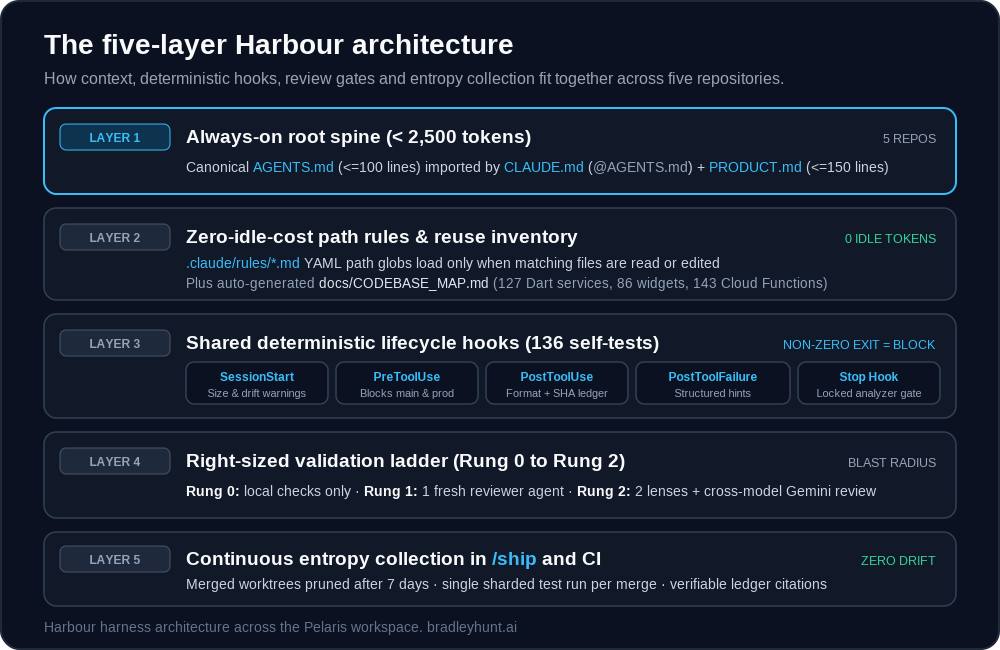
In Harbour, we replaced our entire setup in five layers.
1. One 100-line AGENTS.md, imported everywhere
Claude Code reads CLAUDE.md, while OpenAI Codex, Gemini and Antigravity read AGENTS.md. Worse, placing @docs/conventions.md inside CLAUDE.md expands the entire imported file inline on turn one.
We replaced all of that with a strict rule across all five Pelaris repositories (wayfinder, pelaris-admin, pelaris-io, pelaris-content and pelaris-mcp-server):
AGENTS.mdholds the canonical context: Hard-capped at 100 lines containing our mission, engineering principles, exact build and test commands, and pointers to deeper docsCLAUDE.mdis a single line:@AGENTS.md, so every assistant reads the exact same words from one filePRODUCT.mdsits in the main app repo: Capped at 150 lines defining what Pelaris is, user personas, subscription tiers, our team-sport wedge, and a one-line-per-feature index
2. Path-scoped rules and an auto-generated codebase map
An agent editing a marketing page in Astro does not need 50 KB of Firestore security conventions or Flutter widget rules in working memory. We moved domain rules into .claude/rules/*.md using YAML paths: frontmatter globs, which sit at zero token cost until the agent touches matching files:
| Context Layer | File / Mechanism | When It Loads | Token Cost on Unrelated Tasks | What It Prevents |
|---|---|---|---|---|
| Always-On Core | AGENTS.md (via @AGENTS.md) + PRODUCT.md | Every session start | ~1,800 tokens total | Split-brain product assumptions, wrong CLI commands, scope creep |
| Path-Scoped Rules | .claude/rules/critical-systems.md, workout-engine.md, growth-content.md, windows.md | Only when reading/editing matching file globs | 0 tokens | Touching privacy scrubbers, ID generators, billing or voice copy without area invariants |
| Reuse Inventory | docs/CODEBASE_MAP.md (auto-generated by script) | Linked on demand before creating new services/widgets | 0 tokens at startup (~400 lines when read) | Agents writing a duplicate date formatter, chart helper or Cloud Function |
| Design Lifecycle | design_docs/<stream>/README.md (60-line cap, status frontmatter) | Only when working on that stream | 0 tokens | Grepping through 9,000 dead planning files or re-asking settled decisions |
A short script scans our 127 Dart services, 86 shared widgets, 143 Cloud Function services and 39 coach tools, extracts the file path and its first doc-comment line, and writes docs/CODEBASE_MAP.md. Before an agent writes a new helper, it must check the map and name the existing service it is extending.
3. Deterministic hooks over append-only prose
We moved 105 prose memory rules out of markdown and into five hook events (SessionStart, PreToolUse, PostToolUse, PostToolUseFailure and Stop) committed in .claude/settings.json and backed by a 136-case self-test suite in pelaris-content/harbour/hooks/:
- Never put heavy analyzers in
PostToolUse:PostToolUsefires concurrently during parallel edits, which spawns colliding analyzer processes.PostToolUsenow runs only fast single-filedart formatand logs the command, exit code and commit SHA.flutter analyze --no-fatal-infosruns once per turn in theStophook behind a lock file - Block dangerous commands before they run:
PreToolUseblocks direct pushes tomain, blocks localfirebase deploy, blocks live-AI evaluation runners outside emulators, and refusesgit worktree removeuntil Windowsnode_modulesjunctions are cleanly unlinked - Evidence must be written by tools, not claimed by agents: Following Anthropic’s research on verification loops, hooks log every command execution to
ledger.jsonl, and pull requests cite the ledger line or CI run link verbatim
4. Right-sizing review: the three-rung validation ladder
Forcing heavyweight ceremony onto a ten-line copy fix wastes tokens and trains teams to skip review. We replaced one-size-fits-all panels with a three-rung validation ladder:
- Rung 0 (Self-check): Copy tweaks, small isolated fixes and read-only research use local deterministic checks and hooks only
- Rung 1 (One fresh reviewer): Standard features and protected paths are checked by a fresh agent session that did not write the code
- Rung 2 (Two lenses): Architecture, privacy scrubbing, deterministic IDs, server-side generation and billing are reviewed through two independent lenses plus a cross-model review from Gemini
5. Built-in entropy collection inside /ship and CI
To make sure the mess could not quietly grow back, we built hygiene directly into SessionStart and our /ship skill:
SessionStartdrift checks: Prints a one-line warning ifMEMORY.mdcreeps past 15 KB, ifAGENTS.mdpasses 120 lines, if the checkout is behindorigin/main, or if merged worktrees sit around older than seven days/shipworktree pruning: Automatically removes merged git worktrees older than seven days after verifying clean status and unlinking Windows junctions- Single-pass CI: Running the four-way sharded Flutter test suite on the PR and having deploy verify the proven PR result cut PR CI to roughly 12 minutes and deploy time to 11 minutes
“When an agent makes the same mistake twice, stop writing paragraphs in a markdown file and upgrade the harness.”
What to do if your AI codebase is starting to creak
If your context is starting to fight you, treat the cleanup as one clean weekend cut rather than a phased migration:
- Measure your startup tax: Anything over 100 lines in your root
CLAUDE.mdorAGENTS.mdshould become a path-scoped rule in.claude/rules/or a deterministic hook - Stop using
lessons_learned.mdas a graveyard: If a linter, architectural fitness test, orPreToolUse/Stophook can check a rule, delete the prose - Give agents a map of what exists: Generate a compact
CODEBASE_MAP.mdso agents extend existing foundations instead of inventing parallel helpers - Pull agents back from imaginary edge cases: Require agents to name the existing service they are extending before writing anything new, and make them stop and ask in three bullet points before introducing new infrastructure
Consistency and continual improvement win in sport, in careers, and in software. With AI agents, continual improvement means improving the harbour they sail out of, so every build leaves the system cleaner than it found it.
Read next
Bradley Hunt
AI, engineering & leadership