How we run engineering and product at Pelaris: AI agent squads for code, human craft for creative
Specialized agent squads run mechanical execution across five repositories. Anywhere there is creativity, taste or human connection, people stay on the tools.
Contents
Spend ten minutes reading about AI-native software companies right now and you will see two caricatures. The first is the autopilot fantasy: a company that replaces all engineering, design and marketing with autonomous agents and ships untouched AI output straight to customers. The second is the feature-factory post-mortem: a team that lets agents generate a massive, over-engineered platform in a vacuum and discovers nobody wants to use it.
At Pelaris, we built our organisation around a very different discipline.
Pelaris is an adaptive athletic coaching platform that builds periodised programs for lifting, running, swimming, cycling, triathlon and team sports, then adapts them as your sessions, sleep and life come in. Under the hood, our platform spans five production repositories: a cross-platform Flutter app (wayfinder) with 127 Dart services and 86 shared widgets, 143 Cloud Function services running on Firebase and Vertex AI, an operations console (pelaris-admin), a public web and interactive calculator platform (pelaris-io), a content and governance engine (pelaris-content), and a production OAuth 2.0 MCP server exposing 21 coaching tools to Claude and ChatGPT.
Keeping that architecture moving with institutional quality requires a strict operating split: specialized AI agent squads run our software engineering, testing and CI/CD plumbing, while humans own product strategy, architecture, UI/UX craft, graphic design, and every published word.
The rule that runs Pelaris: automate the plumbing, humanise the surface
When you can generate code, copy, diagrams and layouts in seconds, the temptation is to automate every task on the board just to watch the throughput counter climb. Early on, we tested that boundary and learned a simple truth: users do not care how automated your backend plumbing is, and they care intensely whether a human with taste is standing behind the glass.
“Agents run almost everything mechanical at Pelaris, and humans touch every single surface that requires creativity, taste or trust.”
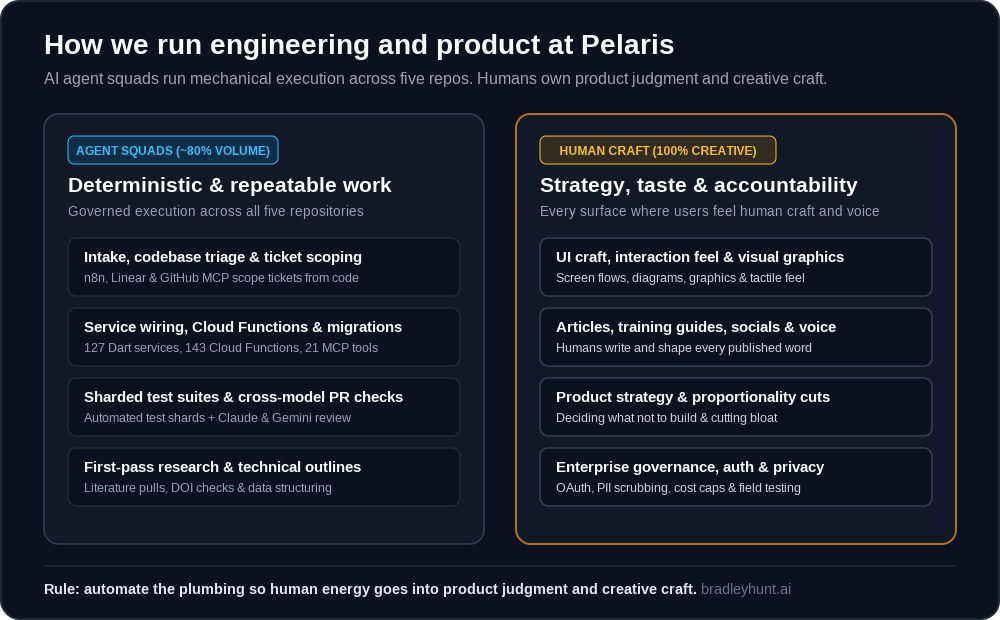
Where AI agent squads run the execution (~80% of operational volume)
Once our five-layer Harbour harness was in place, our product leads could direct specialized agent squads across the predictable parts of software delivery end to end:
- Intake and codebase-grounded triage: When user feedback arrives from the app or a product lead logs a field note, our n8n and Linear pipeline connects to GitHub via MCP, reads the actual files affected, checks existing patterns, and writes a structured sprint ticket with acceptance criteria
- Service implementation and data plumbing: Writing new Cloud Functions, extending Dart services, wiring Firestore queries, updating Zod schemas across the MCP server, and writing migration scripts in isolated git worktrees
- Verification and cross-model review: Running single-file formatters, executing
flutter analyzeinside our lockedStophook, running our four-shard test suite in CI, and performing Rung 1 and Rung 2 cross-model code reviews across fresh Claude and Gemini sessions - First-pass research and data gathering: Pulling PubMed studies, verifying DOIs, assembling comparison tables, checking Search Console performance, and drafting structural outlines
Where human craft stays on the tools (100% of creative touchpoints)
Agents save our team tens of hours a week on research and scaffolding, but they never publish directly to customers. A human hand shapes every creative surface:
- Every article, guide and social post: You can spot raw AI writing from fifty metres away. It hedges, repeats the same cadence, lectures experts on their own sport, and leans on generic phrasing. Agents gather the research and help structure the outline, then humans write and shape the voice so every piece carries real authority
- UI craft and interaction feel: An agent can scaffold a Flutter screen that compiles and passes widget tests in three minutes. It cannot feel whether a workout logging card is too fiddly to tap with wet hands on a pool deck at 6am. We design and refine the UI flows, spacing, typography and tactile interactions by hand
- Graphic design and visual diagrams: Nothing signals low-effort software louder than plastic stock art or generic templates. Whether it is an architectural diagram on this site or a body-blueprint visual in Pelaris, humans direct and edit every visual asset
- Product strategy and scope cuts: Deciding what belongs in the product, what gets cut, and when an agent squad is spiralling into imaginary complexity
Why enterprise governance belongs in an AI-native company from day one
My career is rooted in large-scale enterprise technology and AI, where the classic advice is to bring an entrepreneurial mindset into the enterprise: strip away committee theatre, build a thin working slice, and iterate from real usage data.
Building Pelaris proved that the reverse is just as powerful. In the AI era, you need to bring an enterprise mindset into a product company from day one.
When Component Product Managers orchestrate parallel coding agents, the natural brakes of human typing speed disappear:
- Agents have zero institutional memory between sessions unless you engineer a structured context spine (
AGENTS.md,PRODUCT.md, path-scoped.claude/rules/). Without it, Tuesday’s agent squad will happily invent a second billing helper right next to Monday’s - Agents over-engineer by default. Left unchecked, an agent will build distributed queues for a tiny edge case, burning tokens, CI minutes and cloud spend
- Security and privacy cannot be retrofitted onto health data. When athletes trust us with workout history and body composition scans, two-pass PII scrubbing, OAuth 2.0 PKCE with immediate token revocation, strict Firestore rules, and
PreToolUsehooks that block accidental production commands are non-negotiable from the first release
Why everything at Pelaris is named after the ocean
If you look across our repositories and release notes, you notice a pattern quickly. The company is Pelaris. The internal workspace is Wayfinder. Our colour tokens are named after the coast (Beach, Ocean, Horizon). Our major releases are First Light, Tideway, Spring Tide and Harbour.
That comes from a simple place. I grew up living at the pool and the beach, swam competitively for most of my youth, and still spend as much of my life as I can in the water - swimming in the pool during the week, surfing or hunting for a new open-water swim on the weekends. There is nothing better than completing an open-water swim in a new body of water, or standing on the beach at sunrise listening to the waves before the day starts.
I have also always loved the history of ships and the Age of Exploration, and the idea that the ocean unites all of us around the world. Naming our releases after navigation and the sea keeps our engineering grounded in something human and physical.
Customer Zero: the sub-6-hour marathon swim + marathon run
The best protection against building in an echo chamber is being your own most demanding customer. Right now, I am training to swim a marathon (10 km) and immediately run a marathon (42.2 km) back-to-back in under six hours.
That goal started almost by accident. Despite swimming my whole life, I never really ran until 2024, when I moved to a new area with great running tracks. Someone suggested setting a New Year’s resolution to run a half marathon. My immediate reaction was: why would I want to do half a something? So I set the goal to run a full marathon instead.
Halfway through the build, I felt like I was cheating on swimming with running, so I changed the goal to swim a 10 km marathon and run a 42.2 km marathon in the same year. Once I ticked both of those off in the same year, the natural next step was putting them together: 10 km in the water, straight out onto the road for 42.2 km, under six hours total.
Using Pelaris every day to train for a goal like that exposes every flaw in the product immediately:
- Single-day noise vs long-term trends: Most fitness apps panic after one bad night of sleep and water down your whole week. When you are training for an endurance double while working full-time, you have plenty of imperfect nights where you can still push through. That forced us to build Pelaris around rolling 28-day readiness windows rather than single-night overreactions
- Real-world overrides: Sometimes I turn a planned 3 km pool session into a brick session by running to the pool and running home. Sometimes I am sore, or I have had a Thursday night at the pub, or I am eating my way through a stressful week (I am an emotional eater day-to-day - I eat when stressed, bored, happy or tired, which is half the reason I need to train as much as I do, even though I dial my carbs and recovery drinks in to a tee during events). Telling the coach what actually happened and watching it adapt the next ten days is the ultimate test
- Deterministic guardrails for intervals: Using the app on the pool deck and the track showed us where LLMs struggle on their own. Getting warm-ups, main-set repeats, rest send-offs and pacing targets to line up cleanly on a Garmin watch required deterministic post-translation parsers around the model
“Consistency and continual improvement win everything—in the pool, on the road, and in how you engineer the systems behind a product.”
Four principles for building an AI-native product organisation
Whether you are building a new product company or modernising an enterprise division, the lessons from running Pelaris come down to four rules:
- Draw a hard line between plumbing and taste: Let agent squads own triage, code wiring, test suites and research summaries; keep human hands on UI, visuals, writing and product scope
- Put enterprise guardrails in on day one: Keep your root
AGENTS.mdunder 100 lines, enforce critical rules with deterministic hooks, and lock down security and privacy before scaling traffic - Test the product in the wild: Nothing cuts through AI-generated product fluff faster than relying on your own software when you are tired at 5:45am
- Compound small improvements every week: Improve the harness and the product together so every release makes the whole organisation sharper
Written by Bradley Hunt. For more on AI-first building and enterprise architecture, see the writing index.
Read next
Bradley Hunt
AI, engineering & leadership